Between Two Worlds: How Asian-American Artists Are Building Something Entirely Their Own
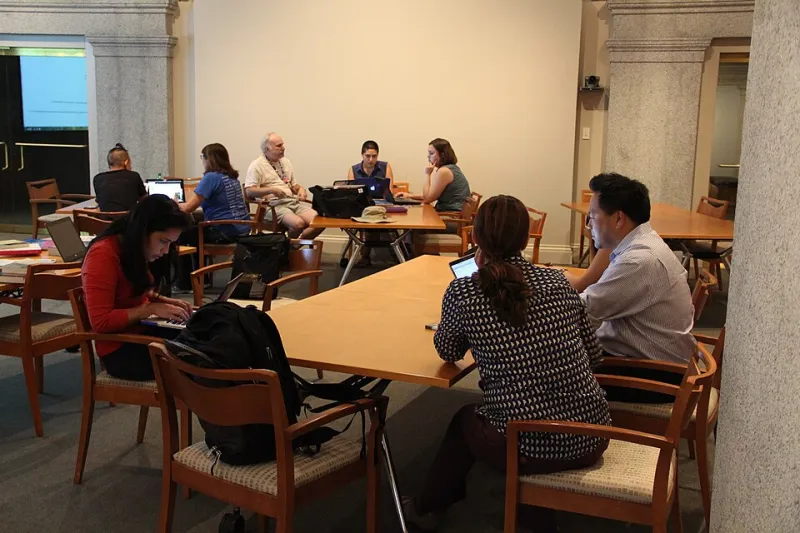
Photo: Fourandsixty, CC BY-SA 4.0, via Wikimedia Commons
The Hyphen Is Not a Limitation
There's a running joke among second-generation Asian kids in America: you grow up being told you're "too Asian" for one crowd and "not Asian enough" for another. For a long time, that hyphen in "Asian-American" felt less like a bridge and more like a tightrope.
But something has shifted. Walk through any major city's emerging arts scene right now — whether it's Flushing, Queens, Chinatown in San Francisco, or the gallery strips of Chicago's West Loop — and you'll find a generation of creatives who have stopped apologizing for standing in the middle. They've planted a flag there instead.
At Liybi Rong Studio, we've been watching this movement unfold up close. The studio's own roots sit at exactly this intersection — Chinese artistic sensibility meeting American creative ambition — and what we're seeing across the broader landscape is nothing short of a cultural renaissance.
Ink Meets Algorithm
Take the work of illustrators who grew up watching their grandmothers practice Chinese calligraphy on Sunday mornings, then spent their teenage years absorbing Marvel comics and Instagram aesthetics. The resulting visual language is genuinely new. Traditional brushwork bleeds into digital linework. Red paper-cut motifs get remixed into streetwear graphics. Ink-wash landscapes show up as looping animations on YouTube channels with hundreds of thousands of subscribers.
This isn't appropriation of one culture by another — it's synthesis from the inside. These artists aren't borrowing from a heritage they observed from a distance. They are the heritage, just evolved and transplanted into a new soil.
Mei Chen, a 26-year-old multidisciplinary artist based in Los Angeles, describes her process this way: "My mom taught me how to do paper cutting when I was maybe seven. I didn't think of it as 'art' then — it was just something we did at New Year. Now I'm doing it digitally, animating it, putting it on merch. It feels like the most natural thing in the world, but people act like it's revolutionary."
Maybe that's because, in the context of mainstream American entertainment, it kind of is.
What Mainstream Media Keeps Getting Wrong
For decades, Hollywood and the broader US entertainment industry had a pretty narrow idea of what Asian-American stories looked like. You got the Tiger Mom narrative. The model minority math genius. The martial arts master. Occasionally, a romantic subplot — but rarely the lead.
The cultural impact of films like Crazy Rich Asians and shows like The Bear (which features a nuanced Asian-American character without making his identity the entire plot) signaled something changing at the top. But the real action has always been happening further down the food chain, in independent spaces where creators aren't waiting for a studio green light.
Podcasts run by first-generation Filipino-Americans dissecting K-drama tropes. Zines by Taiwanese-American illustrators sold at Brooklyn flea markets. YouTube channels where Vietnamese-American comedians riff on the absurdities of growing up between two worlds. These aren't niche projects anymore — they're building audiences that rival legacy media properties.
The Platform Question
One thing that's accelerated all of this? The democratization of creative platforms. You no longer need a gallery show or a record deal or a publishing contract to reach an audience. You need a body of work, a point of view, and somewhere to put it.
This is exactly the philosophy behind spaces like Liybi Rong Studio — the idea that a creative professional with a distinct cultural perspective deserves a platform that reflects both their craft and their identity. Not a watered-down version that makes the work more "palatable" for a general audience, but the full, uncompromised thing.
David Park, a Korean-American graphic novelist who self-published his first book and sold out two print runs entirely through his online presence, puts it plainly: "My publisher told me the story was 'too specific.' I put it out myself and found out it was actually just specific enough. There are a lot of us out here who wanted exactly this story."
That's the thing about specificity — it doesn't limit your audience. It finds your audience.
Challenging Stereotypes Without Making It the Point
Here's what's interesting about the most compelling work coming out of this community: it's not primarily about being Asian-American. It doesn't exist to educate non-Asian audiences or check a representation box. It exists because the artist had something to say, and their cultural background is simply part of the vocabulary they're using to say it.
A ceramicist in Seattle making vessels that fuse Song Dynasty forms with brutalist geometry isn't writing a thesis statement about cultural identity. She's making beautiful objects that happen to carry a whole world of references inside them. A Chicago-based electronic music producer layering erhu samples over trap beats isn't making a political statement — he's making something that sounds incredible and happens to reflect who he actually is.
The stereotype-busting is almost a side effect of the authenticity. When you're fully yourself, you automatically complicate anyone's attempt to flatten you into a type.
Where This Goes Next
The honest answer is that nobody knows exactly where this movement lands in ten years. What's clear is that the infrastructure is being built right now — the platforms, the communities, the visual languages, the business models — that will make it sustainable.
At Liybi Rong Studio, we believe that amplifying these voices isn't charity work. It's recognizing where the most interesting creative energy is actually flowing. The American creative landscape has always been at its best when it's genuinely plural — when it reflects the full, complicated, hyphenated reality of who actually lives here.
The artists building that future aren't waiting for permission. They're already working.