The Side Project Economy: Why Your Passion Work Is Actually Your Most Valuable Asset
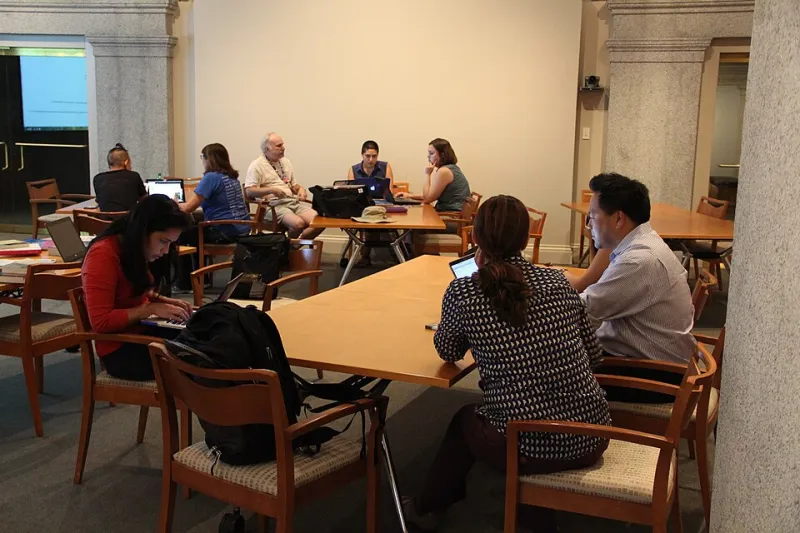
Photo: Tindel, CC BY 4.0, via Wikimedia Commons
The Weird Math of Passion Projects
Here's something that doesn't quite add up on paper: you spend your weekends making something nobody asked for, you're not getting paid, and yet somehow—somehow—it ends up being the thing that changes everything about your career.
Welcome to the side project economy. It's messy, it's personal, and increasingly, it's where real creative careers are being built.
We're living through a strange moment where the line between hobby and hustle has basically dissolved. Not because everyone needs a side hustle (that particular brand of productivity guilt can stay in 2019), but because the economy genuinely rewards people who can demonstrate range, curiosity, and the ability to create something from nothing. Your passion project does all three simultaneously.
What "Professional Currency" Actually Means in 2024
Let's get specific. When people talk about passion projects as "professional currency," they're usually being vague about the mechanism. So let's break it down.
First, there's the portfolio effect. A project you built purely for yourself—with no client brief, no budget constraints, no compromise—shows your actual creative ceiling. Clients and collaborators can see what you do when nobody's watching. That's genuinely rare and valuable.
Second, there's what psychologists call self-efficacy building. Every time you finish something difficult that you chose to do, you recalibrate your sense of what's possible. Illustrator and designer Jing Wei, whose work has appeared in The New York Times and on book covers across the country, has talked openly about how her personal illustration practice—work she did purely because she wanted to—became the foundation for her entire professional identity. The commercial work followed the personal work. Not the other way around.
Third—and this one's underrated—side projects create community entry points. When you share work that's genuinely yours, you attract people who respond to that specific thing. That's a much stronger professional network than anything you'll build at a networking happy hour.
Real Pivots, Real People
Take the trajectory of someone like Timothy Goodman, the New York-based graphic artist who became widely known partly through personal projects that were essentially social experiments. His collaborative project with Jessica Walsh, 40 Days of Dating, started as a personal creative exercise—two friends documenting a real-life experiment. It went viral, became a book, became a film. None of that was the plan. The plan was just to make something honest.
Or consider what's happening in the ceramics space right now. Dozens of artists who started throwing pots on weekends as a stress release from tech jobs have turned those practices into six-figure Etsy businesses, workshop series, and brand collaboration deals. The through-line isn't luck. It's the fact that work made with genuine love reads differently than work made to spec. People can feel it.
This isn't just an art world phenomenon either. A software developer who builds a niche productivity tool for their own use and shares it openly has a portfolio piece that's worth more than any freelance project. A food writer who documents their grandmother's recipes on Substack builds an audience that a polished food magazine pitch never could.
The Psychology of Creative Risk-Taking
Here's where it gets interesting. Most people don't start passion projects because they're strategically planning their career moves. They start them because something won't leave them alone. There's an idea, a medium, a question that keeps showing up.
Psychologists who study creativity point to something called intrinsic motivation as the core driver of breakthrough work. When you're not worried about whether something will sell, you make different choices. Bolder ones. You follow the weird thread. And weird threads, it turns out, are exactly what cut through the noise in an oversaturated market.
The risk-taking that feels scary in a passion project—trying a new medium, sharing something vulnerable, building in public before you're ready—is actually the thing that makes the work worth paying attention to. Failure in a side project is low-stakes. But the lessons transfer directly to your main work.
Practical Ways to Monetize Without Killing the Magic
Okay, so how do you actually make money from something that started as pure creative expression without turning it into a soulless content machine?
Start with the adjacent revenue streams. If you make paintings, you don't have to sell the paintings. You can sell prints, teach workshops, license the images, or use them to attract brand collaborations. The original work stays sacred; the derivatives generate income.
Document the process, not just the product. Behind-the-scenes content about how you make your work is often more compelling—and more monetizable—than the finished pieces. People pay for access, education, and inspiration as much as they pay for objects.
Find your 1,000 true fans. Kevin Kelly's old concept holds up. You don't need a million followers. You need a smaller audience who genuinely cares about what you're doing and will support it financially. A newsletter, a Patreon, a limited edition drop—these work when the work is specific and real.
Pitch the story, not just the work. Editors, brands, and collaborators are often as interested in the narrative of how something was made as they are in the thing itself. The fact that your project started as a personal experiment is part of its value. Lead with that.
The Investment That Pays Compound Interest
Here's the reframe that might actually change how you think about your creative time: your side project isn't a distraction from your career. It's the R&D department.
Every hour you spend on work that's fully yours is an investment in a version of yourself that's harder to commodify, harder to replace, and more interesting to work with. In a market where AI can approximate a lot of competent work, the thing that remains irreplaceable is a distinct creative perspective built over time through genuine making.
Your side project is the long game. And right now, the long game is the only one worth playing.